
- Event
"Create synergies driven by and centered around the collections"
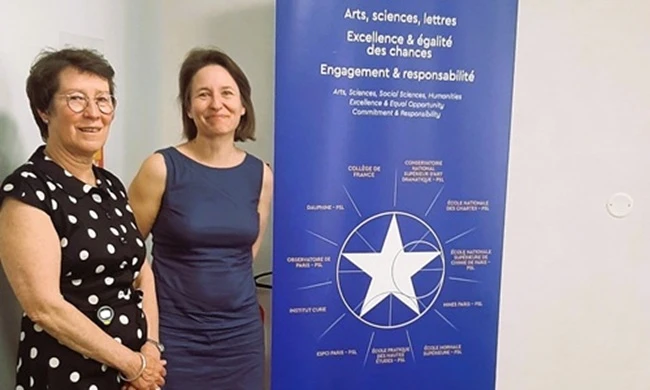
Interview with Emmanuelle Chapron and Muriel Le Roux, Co-Leads of the PSL Major Research Programme Faire collection
PSL: How did the idea for this major research programme originate, and what are its key objectives?
Emmanuelle Chapron: In 2022, together with Émilie d’Orgeix, then Vice President for Research at EPHE, we became aware of the PSL call for Major Research Programmes. It struck us as a remarkable opportunity to build bridges between our institutions. What common denominator could we identify among colleagues who do not usually interact—or who might not even know each other? We all work with objects, books, ancient inscriptions, manuscripts, samples, and data, in all their diversity, within institutions that house them or that we ourselves curate. The title Faire collection was conceived informally, almost offhand. Émilie d’Orgeix then contacted Valérie Theis, Deputy Director of the ENS for Letters and Social Sciences.
Muriel Le Roux: On multiple occasions, I had explained that writing the history of contemporary sciences necessarily involves archives and objects, through collections of all kinds. Valérie Theis put me in touch with Emmanuelle; we did not know each other beforehand, but very quickly we realized that our expertise was complementary. The idea of Faire collection then took shape and evolved into a programme reflecting on the heritage of PSL institutions.
Muriel Le Roux: As for the objectives, the aim is to combine research on collections with the need for pedagogy regarding the fragility of collections from the modern and contemporary periods, encompassing all types of collections and all artifacts of science in the making. By the conclusion of its work, Faire collection will provide guidance for researchers.
Emmanuelle Chapron: It is also about rethinking scholarly collectives, fostering a sense of community within the highly diverse context of PSL. We need to reconsider what objects have contributed to shaping these scholarly communities.
PSL: What are the main research directions and the teams involved? How will they collaborate to achieve the programme’s objectives?
Emmanuelle Chapron: Faire collection brings together 13 research units and 11 institutions. Meetings with the various teams help identify commonalities that will serve as research directions for the coming years. The goal is not for each team to work in isolation on “their” collection, especially since collections are often shared from the outset: they constitute a heritage that is far more scientific than institutional. The aim is to generate synergies, with the collections serving as both the driving force and the core.
Muriel Le Roux: Our approach is multidisciplinary, multi-collection, and spans multiple institutions within PSL. Faire collection represents a republic of letters and sciences, an open space for exchange. It seeks to revive a community of scholars that institutional history tends to obscure, with research teams capable of quickly adapting to an organization and carving out their own working spaces within it.
PSL: What constitutes a collection today, and in what ways is it a subject of research for scientists?
Emmanuelle Chapron: As Anne-Solène Rolland of the Musée du Quai Branly [and external expert member of the Faire collection Scientific Council] puts it, “a collection today is what a researcher makes of it.” Collections may exist in institutionalized forms, but one must continually consider the practices that constitute them, bring them into being, and put them at the service of research. Some collections, moreover, have no institutional existence yet function fully as research tools.
Muriel Le Roux: Collections are established in a specific place, but they are interpreted by researchers from different perspectives and historical contexts, which gives rise to new ways of understanding the objects.
PSL: Do you have an example of a collection—whether historic, forgotten, or currently being formed—that particularly illustrates the programme’s objectives?
Muriel Le Roux: The collections at IBENS! These are collections of science in the making, from molecules to living organisms, as used by the researchers at IBENS, a partner team of Faire collection.
Emmanuelle Chapron: The palaeography facsimile collection at the École des Chartes. It is a “fossil” collection, no longer in active use, yet studying it effectively brings it back to life as a living collection. Questions about what to do with it—whether as an object of study on the practices of reproducing written documents since the early 19th century, as a work of art, or for donation—give new purpose to a collection that might otherwise seem obsolete. Do objects constitute a collection because of their utility, or because they no longer have any? It is the critical inquiry prompted by these objects that gives meaning to the collection.
In this sense, Faire collection engages, reflexively, all other Major Research Programmes !